


RFID Card Reader – What Is It?
Contents List
- Introduction to RFID Card Readers
- What Is an RFID Card Reader?
- Main Components of an RFID Card Reader
- How Does an RFID Card Reader Actually Read and Work?
- RFID Frequencies: LF, HF, and UHF
- RFID Card Reader Read Range
- RFID Card Reader Communication Standards
- How an RFID Card Communicates With a Reader?
- Types of RFID Card Readers
- Types of RFID Cards
- Materials of RFID Cards
- Difference Between RFID Card Reader vs. NFC Reader
- RFID Card Reader vs. Magnetic Stripe and Barcode Readers
- Applications of RFID Card Readers
- Advantages of RFID Card Readers
- Limitations and Challenges of RFID Card Readers
- How to Choose an RFID Card Reader?
- RFID Card Reader Security Considerations
- Frequently Asked Questions
- Conclusion
Reading Time is 20 minute
1- Introduction to RFID Card Readers
Organizations are keen on finding more efficient, quicker and secure ways to manage access, keep track of their assets and simplify their processes in the digital world that moves very quickly. One of the many technologies that lead to this change is the use of RFID (Radio Frequency Identification), which has become an important turning point. The use of RFID technology is widespread, have become an essential part of modern digital infrastructure. From opening office doors and accessing hotel rooms to enabling contactless payments and tracking assets, RFID cards quietly power countless everyday interactions. While many people use them daily, few understand the technology behind them.

This guide explains everything you need to know about RFID cards, including how they work, the different types available, common applications, and how to choose the right RFID card for your project.
2- What Is an RFID Card Reader?
RFID stands for Radio Frequency Identification where RFID cards rely on radio frequency identification technology, a wireless communication method that allows data to be transmitted between a card and a reader without physical contact. This simple yet powerful system enables fast authentication, secure identification, and automated data collection across many industries.
RFID system does not require optical line-of-sight between the reader and the identification device. Depending on the RFID technology being used, a reader can communicate with a card when it is placed close to the reader or, in other applications, detect tags from considerably greater distances.
An RFID Card Reader is an electronic device that uses radio-frequency signals to communicate wirelessly with an RFID card or other RFID transponder.
The RFID reader generates an electromagnetic field or radio-frequency signal. When a compatible RFID card enters the reader’s operating area and the card and reader establish communication.
The RFID reader detects the card, communicates with its embedded RFID chip Given that this device designed to wirelessly read information stored on, or associated with, an RFID card and transfers the resulting identification or other permitted data to a and sends that information to another electronic system for processing (host system).
An RFID card generally contains an RFID integrated circuit (IC) and antenna. Depending on the technology, the card may be passive and obtain the energy required for communication from the reader’s electromagnetic field. Passive RFID tags do not require their own battery.

A simplified system can therefore be represented as:
RFID Card → RFID Reader → Host Controller/Computer → Application Software
The RFID reader is the communication interface between the physical RFID card and the digital system.
Today, RFID cards are widely used in access control systems, public transportation, membership management, supply chain tracking, healthcare identification, and financial payments. Their durability, convenience, and scalability make them a preferred identification solution for businesses, governments, and institutions worldwide.
3- Main Components of an RFID Card Reader
Although implementations vary, an RFID reader generally contains several important functional blocks.

RF Transceiver
The RF transceiver generates and receives radio-frequency signals.
It contains the electronics necessary to transmit commands and detect the response from the RFID card.
Reader Antenna
The antenna couples the reader to the RFID card.
Its design depends strongly on the operating frequency and application.
For short-range HF/NFC-style card systems, antenna coils are commonly used. For other RFID technologies, different antenna structures may be required.
RFID Reader IC
The reader IC, sometimes called an RF front end or NFC/RFID frontend, handles much of the low-level RF communication.
Modern reader ICs can support multiple protocols and communication modes.
For example,
NXP’s PN5180 supports reader/writer operation for standards including ISO/IEC 14443-A, ISO/IEC 14443-B, ISO/IEC 15693, and ISO/IEC 18000-3.
Microcontroller or Processor
A microcontroller may control the reader IC and handle:
- protocol management
- card detection
- data processing
- authentication
- communication with the host
- application logic
In some products, these functions are integrated into a single module.
Host Communication Interface
The reader needs a way to communicate with the external system.
Depending on the design, interfaces can include:
- USB
- UART
- SPI
- I²C
- Ethernet
- RS-232
- RS-485
- wireless interfaces
The appropriate interface depends on the reader’s intended application.
4- How Does an RFID Card Reader Actually Read and Work?
An important point is that an RFID reader does not necessarily read a person’s name, access permission, or other application information directly.
The RFID card may contain an identifier or other data. The reader retrieves the information that the particular RFID technology and security configuration allow it to access. The application software can then use that information to determine what action should be taken.
For example:
Card → Card identifier → Reader → Access-control system → Access granted or denied
This distinction is important because the reader performs communication, while the application system normally performs the higher-level decision-making.
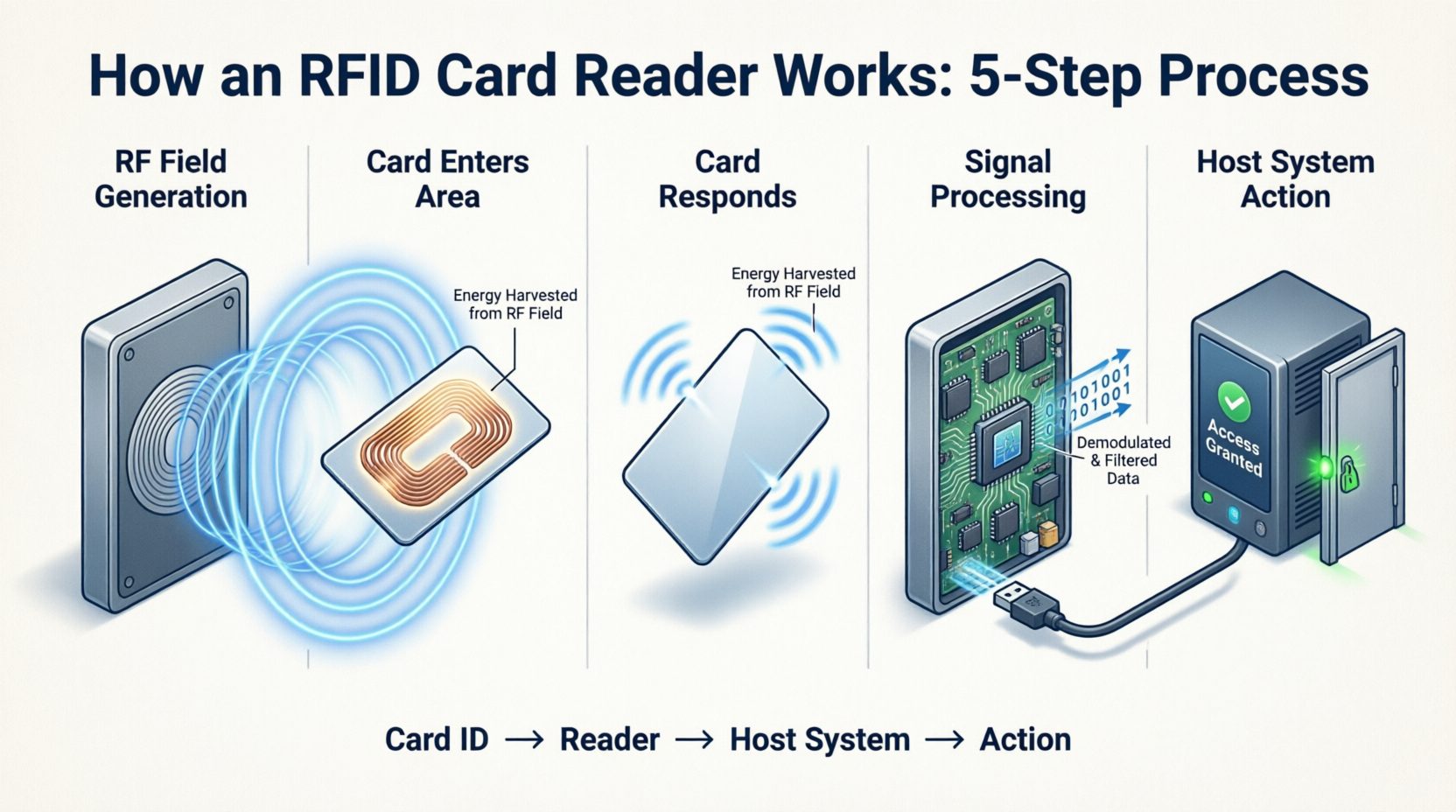
The exact communication method depends on the RFID technology, frequency, card type, and protocol. However, the general process can be explained in several steps.
Step 1: The Reader Generates an RF Field
The RFID reader activates its RF circuitry and antenna.
For passive RFID technologies, the reader’s RF field can provide the energy required by the card or tag. GS1 describes passive UHF RFID readers as transmitting a continuous-wave signal that provides operating energy to passive tags.
Step 2: The RFID Card Enters the Operating Area
When a compatible card comes within the reader’s effective range, the card’s antenna interacts with the electromagnetic field.
For passive cards, the received RF energy can be converted into electrical energy to operate the RFID IC.
Step 3: The Card Responds
The RFID IC processes the reader’s request and responds according to the communication protocol.
The exact mechanism differs between RFID technologies.
For example, passive UHF RFID commonly uses backscatter, in which the tag changes the way it reflects the reader’s RF signal. The reader detects those changes and interprets them as data.
Step 4: The Reader Demodulates and Processes the Signal
The reader’s RF section receives the response from the card.
Its electronics then perform functions such as:
- RF signal reception
- filtering
- amplification
- demodulation
- protocol processing
- error handling
- data extraction
The result is digital information that the reader can provide to a host system.
Step 5: The Host System Processes the Data
The reader sends the resulting data to a controller, computer, embedded system, or application.
Depending on the application, this may result in:
- unlocking a door
- recording attendance
- identifying a user
- validating a ticket
- recording an inventory event
- authenticating a card
- updating a database
Therefore, an RFID reader is best understood as a radio communication device and data interface, rather than as a complete access-control or identification system by itself.
5- RFID Frequencies: LF, HF, and UHF
RFID is not a single radio technology. RFID systems operate at different frequency ranges, and each range has different characteristics.
Low Frequency (LF) RFID
LF RFID systems commonly operate around 125 kHz or similar low-frequency bands, depending on the specific system.
They generally provide relatively short read ranges and are often used for applications such as:
- animal identification
- vehicle immobilizers
- basic identification systems
- access-control applications
High Frequency (HF) RFID
HF RFID operates at 13.56 MHz.
HF technology is particularly important for cards and near-field applications.
Examples include:
- contactless cards
- access cards
- library cards
- NFC-related applications
- ticketing systems
ISO/IEC 18000-3 specifies RFID air-interface parameters for 13.56 MHz systems.
Ultra-High Frequency (UHF) RFID
UHF RFID operates in the UHF region. Passive UHF RFID is widely associated with RAIN RFID and EPC Gen2 technology.
GS1 identifies UHF EPC/RFID as operating in the 860–960 MHz range, while regional regulatory requirements determine the specific frequencies and power limits used in a particular country.
UHF RFID is particularly important for:
- supply chains
- inventory
- logistics
- retail
- asset tracking
It is generally not the technology people mean when discussing a typical short-range contactless access card.
6- RFID Card Reader Read Range
The read range of an RFID reader is not a universal number.
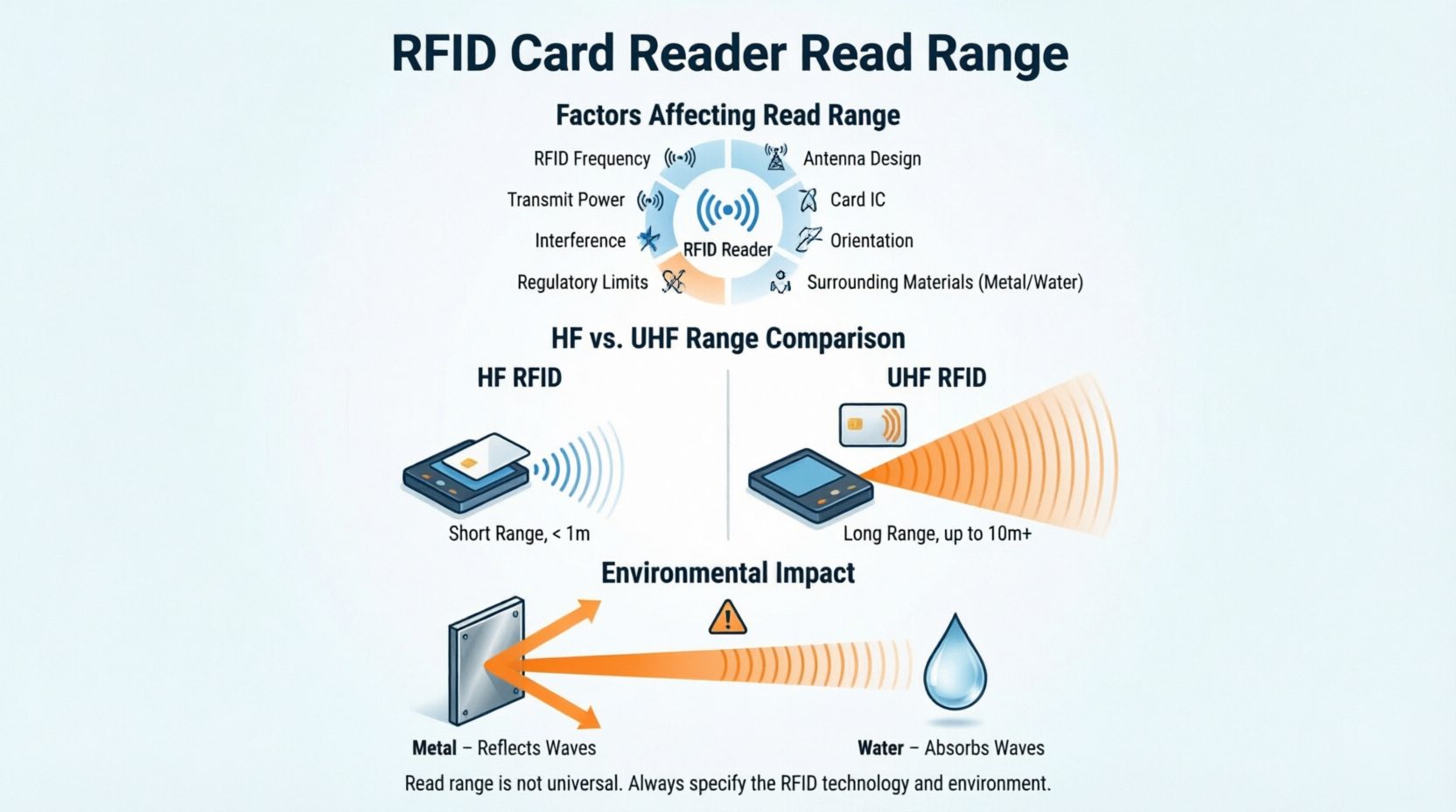
It depends on several factors, including:
- RFID frequency
- reader transmit power
- antenna design
- card antenna
- card IC
- orientation
- surrounding materials
- electromagnetic interference
- regulatory limits
- communication protocol
- reader sensitivity
HF card systems are generally intended for relatively short-range operation, while UHF RFID systems can provide substantially longer read distances.
For this reason, technical specifications should not simply state that “RFID works up to X meters” without identifying the RFID technology.
RFID Journal explains that different RFID frequencies have different propagation characteristics and that materials such as metal and water can significantly affect performance, particularly in UHF systems.
7- RFID Card Reader Communication Standards
An RFID reader and card must use compatible communication technologies.
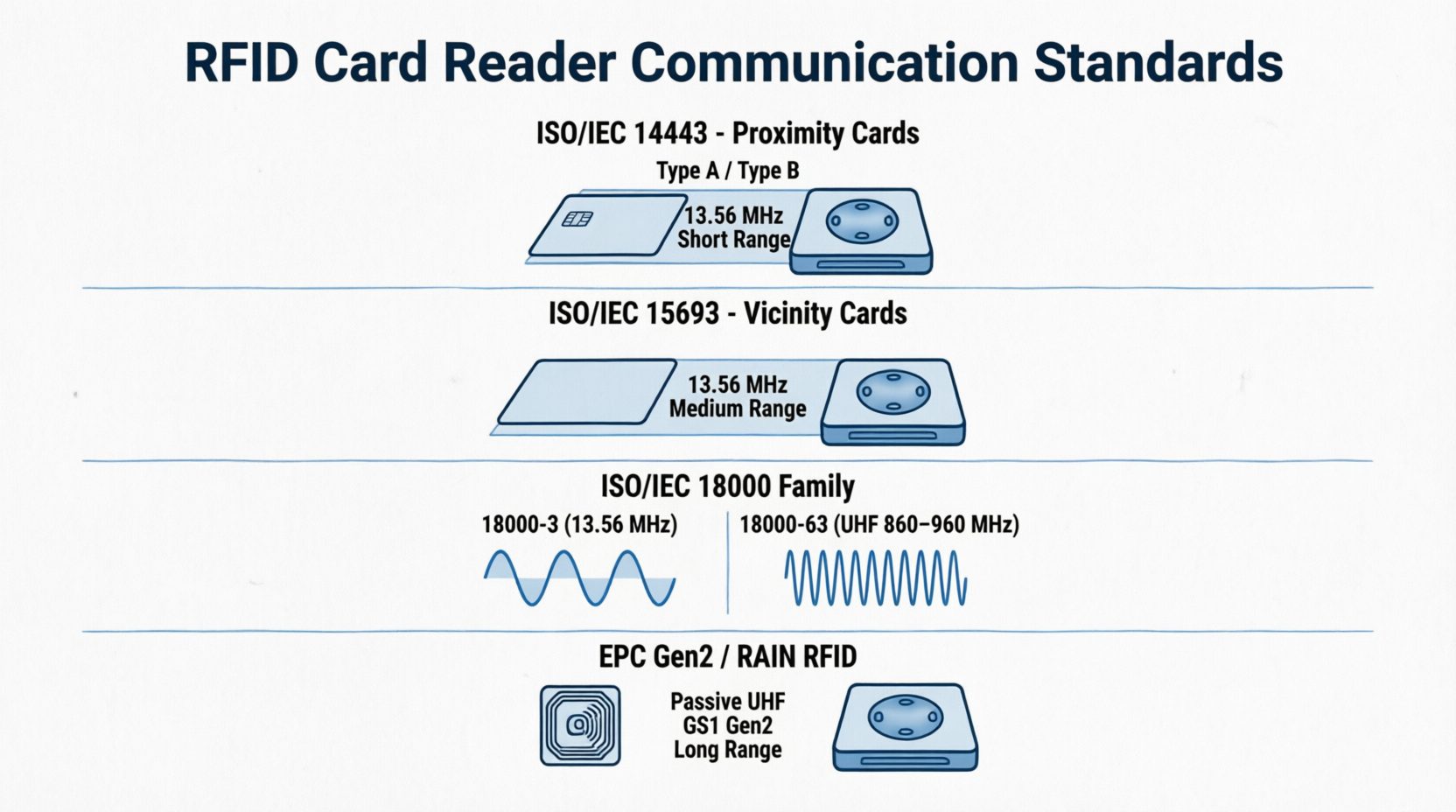
Important standards and technologies include:
ISO/IEC 14443
ISO/IEC 14443 is particularly important for proximity cards and contactless applications.
Different implementations can use Type A or Type B technologies.
NXP, for example, lists ISO/IEC 14443-A and ISO/IEC 14443-B among the reader/writer modes supported by its PN5180 reader IC.
ISO/IEC 15693
ISO/IEC 15693 is associated with vicinity-card applications and 13.56 MHz RFID technology.
It can support longer operating distances than some proximity-card technologies, depending on implementation and operating conditions.
ISO/IEC 18000
The ISO/IEC 18000 family defines RFID air-interface standards for different frequency ranges.
For example:
- ISO/IEC 18000-3 — 13.56 MHz
- ISO/IEC 18000-63 — UHF RFID around 860–960 MHz
GS1’s UHF Gen2 technology is closely aligned with ISO/IEC 18000-63.
EPC Gen2 / RAIN RFID
EPC Gen2 is a major standard for passive UHF RFID.
GS1’s current Gen2 specification is version 3.0.1, published in February 2026. It defines the air-interface protocol for UHF RFID communication.
8- How an RFID Card Communicates With a Reader?
The communication between an RFID card and reader depends on the RFID frequency and protocol.

For a passive RFID system, the reader generally initiates communication. The card responds using the mechanism defined by its air-interface protocol.
In passive UHF RFID, for example, the reader sends RF energy and commands, while the tag uses backscatter to return information. GS1 describes this process as the tag changing the reflection characteristics of its antenna to return information to the reader.
For HF card technologies, communication is based on electromagnetic coupling at 13.56 MHz. ISO/IEC 18000-3 specifies air-interface parameters for RFID systems operating at 13.56 MHz.
This is one reason why the term “RFID” alone is not sufficient to identify how a particular card reader works.
9- Types of RFID Card Readers
RFID card readers can be categorized in several ways.
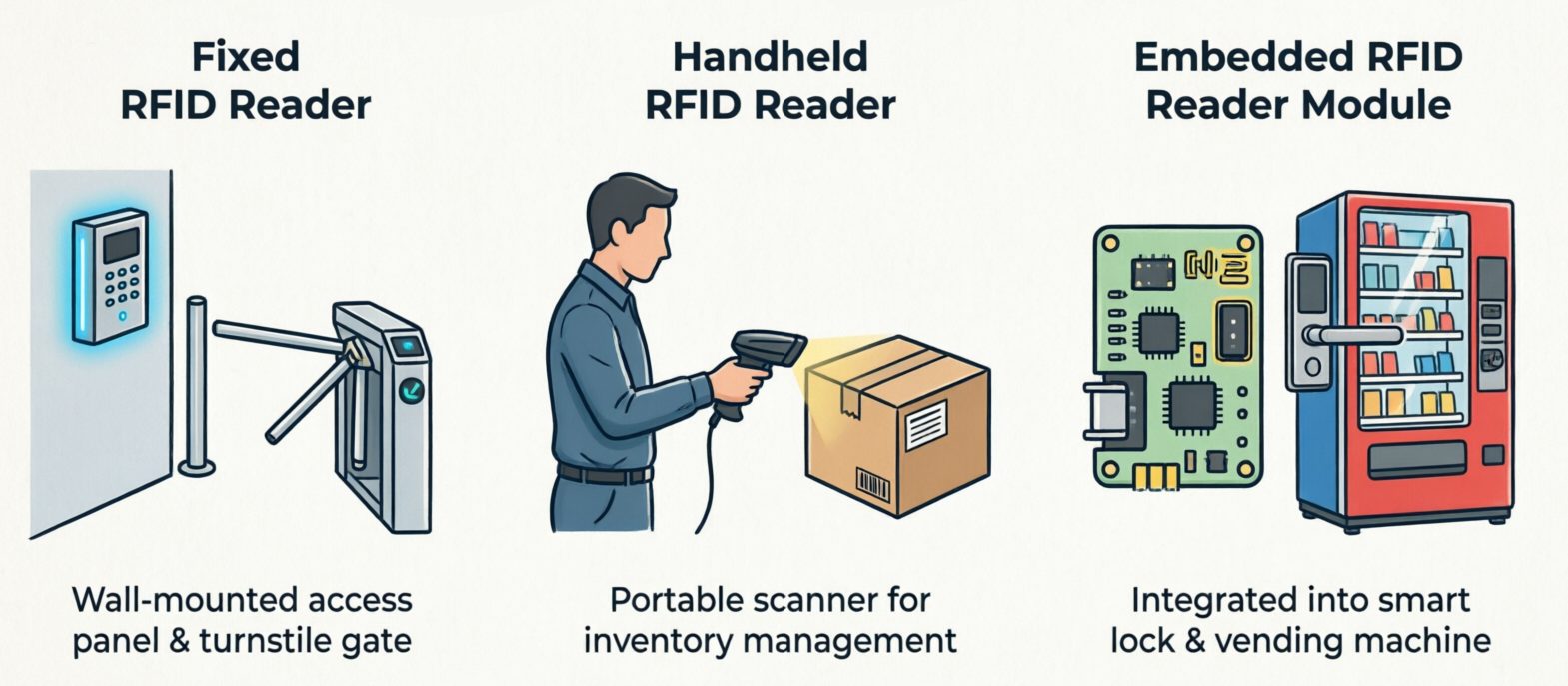
Fixed RFID Readers
A fixed RFID reader is installed permanently at a particular location.
Typical examples include:
- door access systems
- gates
- turnstiles
- vehicle identification points
- industrial stations
The reader remains in one location while cards or tags are brought into its operating area.
Handheld RFID Readers
A handheld RFID reader combines the RFID electronics with a portable device.
These readers are useful for applications such as:
- inventory management
- asset tracking
- warehouse operations
- field inspection
- maintenance
Embedded RFID Reader Modules
An embedded reader module provides RFID functionality that can be integrated into another product.
For example, an engineer may integrate an RFID/NFC reader module into:
- an access-control terminal
- vending equipment
- an IoT device
- an industrial controller
- a smart cabinet
- an electronic lock
This approach allows the product designer to focus on the overall application instead of designing the complete RF reader from scratch.
10- Types of RFID Cards
An RFID card is a card-shaped RFID transponder.
A typical RFID card can contain:
- an RFID IC
- an antenna
- card substrate
- protective layers
- optionally, printed identification information
The antenna and IC together form the fundamental RFID communication element.

Passive RFID Cards
- A passive RFID card does not normally contain a battery.
- Instead, it receives energy from the reader’s RF field.
- This makes passive cards relatively simple, compact, and suitable for applications where the card is presented close to a reader.
Active RFID Cards
- Active RFID devices contain their own power source, usually a battery.
- They can communicate over greater distances than many passive systems, but their size, cost, maintenance requirements, and power consumption can be higher.
- RFID Journal distinguishes passive and active systems based partly on whether the tag has its own power source and transmitter.
11- Materials of RFID Cards
RFID cards can be manufactured using different materials depending on durability requirements, environmental conditions, and branding needs.
PVC RFID Cards
PVC is the most common material used for RFID cards.

It offers several advantages:
- Low manufacturing cost.
- Excellent print quality.
- Compatibility with standard card printers.
- Smooth surface for graphics and branding.
PVC RFID cards are widely used for ID badges, membership cards, and access cards.
PET RFID Cards

- PET cards provide better durability and heat resistance compared to PVC.
- They are suitable for environments where cards may be exposed to higher temperatures or mechanical stress.
ABS RFID Cards
ABS plastic is commonly used for RFID key cards and key fobs.

These cards are thicker and more rugged, making them ideal for applications such as:
- Hotel room access cards.
- Gym membership tags.
- Industrial access control systems.
Wooden RFID Cards

- Wooden RFID cards are becoming popular in eco-friendly branding applications.
- Luxury hotels, resorts, and environmentally conscious businesses often use wooden cards to promote sustainability.
Epoxy RFID Tags

- Epoxy RFID cards are coated with a protective epoxy layer that makes them highly durable and waterproof.
- They are often used as small keychain tags or promotional tokens.
12- Difference Between RFID Card Reader vs. NFC Reader
| Feature | RFID | HF RFID | NFC |
|---|---|---|---|
| Meaning | A broad family of radio-frequency identification technologies | A specific RFID technology operating in the high-frequency range | A short-range wireless communication technology closely related to HF RFID |
| Frequency | Can operate at different frequencies, including LF, HF, and UHF | 13.56 MHz | 13.56 MHz |
| Technology Scope | Broad category | One category within RFID | A specific technology based on 13.56 MHz communication |
| Typical Read/Communication Range | Depends on the RFID technology | Generally short range | Very short range |
| Typical Applications | Access control, inventory, logistics, asset tracking, identification | Contactless cards, access control, libraries, ticketing | Smartphones, contactless payments, digital credentials, device-to-device communication |
| Communication | Depends on the specific RFID technology and protocol | Uses HF RFID communication protocols | Uses NFC-defined communication modes and protocols |
| Relationship | Broad technology family | Part of the RFID family | Closely related to HF RFID |
| Can It Read RFID Cards? | Depends on the reader’s supported frequency and protocols | Yes, when the card uses a compatible HF technology | Can read certain 13.56 MHz RFID cards, depending on the supported technology and protocol |
| Examples of Standards/Technologies | ISO/IEC 18000 family, EPC/RAIN RFID, HF RFID | ISO/IEC 14443, ISO/IEC 15693 | NFC Forum technologies and ISO/IEC 14443-based technologies |
| Main Advantage | Supports many identification applications across different frequencies | Well suited to short-range contactless cards | Designed for convenient short-range communication between compatible devices |
13- RFID Card Reader vs. Magnetic Stripe and Barcode Readers
RFID differs significantly from traditional identification technologies.
| Parameter | RFID | Barcode | Magnetic Stripe |
|---|---|---|---|
| Communication | Radio frequency | Optical | Magnetic |
| Physical contact | Usually not required | No | Usually close/contact |
| Line of sight | Often not required | Usually required | Not required |
| Multiple tags/cards | Some RFID systems support multiple tags | Typically one at a time | Typically one card |
| Data storage | RFID IC memory may store data | Printed/encoded optical pattern | Magnetic stripe data |
| Reusable | Yes | Depends on label | Yes |
| Susceptibility to physical damage | Depends on card construction | Label can be damaged | Stripe can wear |
One of RFID’s important advantages is that the reader does not need to optically see a printed code. RFID Journal describes RFID as enabling readers to capture tag information without the manual optical scanning associated with conventional barcode systems.
14- Applications of RFID Card Readers
RFID card readers are used in many applications.

Access Control
An RFID card can be assigned to a user or credential.
When the card is presented to a reader, the system can determine whether the credential is authorized.
Applications include:
- offices
- laboratories
- schools
- hotels
- industrial facilities
- restricted areas
Employee Attendance
Employees can use RFID cards to register:
- arrival
- departure
- breaks
- shift information
The reader transfers the card information to an attendance system.
Transportation and Ticketing
RFID and contactless technologies can be used for:
- transit cards
- event tickets
- toll systems
- fare collection
The exact technology varies according to the application.
Libraries
Libraries can use RFID to identify books and other media.
RFID systems can automate:
- check-in
- check-out
- inventory
- item identification
- anti-theft functions
Inventory and Asset Tracking
UHF RFID is particularly useful when many objects need to be identified quickly.
RAIN RFID systems can read multiple tags without requiring direct line-of-sight, making them useful in supply-chain and inventory applications.
15- Advantages of RFID Card Readers
RFID card readers provide several advantages.
Contactless Operation
Users generally do not need to insert a card into the reader.
The card can simply be presented within the reader’s operating area.
Fast Identification
RF communication allows the reader to identify a compatible card quickly.
No Optical Line of Sight
Unlike a barcode reader, an RFID reader does not depend on visually scanning printed information.
Automation
RFID identification can be integrated into automated systems with minimal user interaction.
Compact Hardware
RFID reader modules can be relatively compact, making them suitable for embedded products.
Flexible Data Communication
Depending on the card and protocol, RFID systems can support more than a simple fixed identifier.
16- Limitations and Challenges of RFID Card Readers
RFID technology also has limitations.
Card and Reader Compatibility
An RFID reader cannot automatically communicate with every RFID card.
The reader must support the relevant:
- frequency
- modulation
- protocol
- card technology
- security mechanisms
RF Interference
- Other electromagnetic sources can interfere with RFID communication.
- Good RF design, antenna placement, filtering, and system testing are therefore important.
Metal and Other Materials
- Materials surrounding an RFID antenna can affect its performance.
- RFID Journal notes that metal and water can create particular challenges for certain RFID systems, especially UHF implementations.
Read Range Is Application-Dependent
- A reader advertised with a particular read distance may not achieve that distance in every installation.
- Antenna orientation, card design, environment, and regulatory restrictions all matter.
Security Is Not Automatic
- Simply using RFID does not automatically make a system secure.
- Security depends on the card technology, authentication mechanism, encryption, credential management, reader implementation, and application architecture.
17- How to Choose an RFID Card Reader?
Choosing an RFID reader should start with the card and application requirements, not simply the reader’s advertised range.
Identify the Card Technology
First determine whether the application uses:
- LF RFID
- HF RFID
- NFC
- UHF RFID
- A specific proximity-card technology
Determine the Required Read Distance
Ask whether the card will be:
- presented directly to the reader
- held a few centimeters away
- detected from a larger distance
A short-range access-control card reader and a warehouse UHF reader have very different requirements.
Check Protocol Compatibility
The reader must support the protocol used by the card.
Examples include:
- ISO/IEC 14443
- ISO/IEC 15693
- ISO/IEC 18000
- EPC Gen2
Consider the Host Interface
Select an interface compatible with the controller or computer.
Common choices include:
- USB
- UART
- SPI
- I²C
- Ethernet
- RS-232
- RS-485
Evaluate Security Requirements
For an access-control or authentication application, investigate:
- authentication
- encryption
- secure key storage
- credential management
- replay protection
- reader-to-controller security
- card cloning resistance
Consider the Installation Environment
For industrial applications, evaluate:
- temperature
- humidity
- dust
- vibration
- electromagnetic interference
- nearby metal
- mounting position
- power availability
18- RFID Card Reader Security Considerations
Security deserves special attention when RFID cards are used for access control or authentication.

An RFID system may involve several security layers:
Card security → RF communication → Reader security → Controller security → Application security
A simple card identifier should not automatically be treated as a strong authentication credential.
For security-sensitive applications, engineers should examine the exact card technology and its authentication capabilities rather than choosing a reader based only on frequency.
It is also important to distinguish identification from authentication.
Identification asks: “Which credential is this?”
Authentication asks: “Can this credential prove that it is legitimate?”
Those are different security functions.
GS1 also recognizes privacy and security considerations in RFID deployments and provides guidance concerning consumer notice, choice, and handling of information associated with EPC/RFID systems.
19- Frequently Asked Questions
What is an RFID card reader?
An RFID card reader is an electronic device that communicates wirelessly with a compatible RFID card and retrieves permitted identification or other card data.
How does an RFID card reader work?
The reader generates an RF signal or electromagnetic field, detects a compatible card, communicates with its RFID chip according to a defined protocol, receives the response, and sends the resulting data to a host system.
Does an RFID card need a battery?
Not necessarily. Many RFID cards are passive and obtain the energy required for communication from the reader’s RF field.
What frequency do RFID cards use?
There is no single RFID frequency. RFID technologies include LF, HF, and UHF. Many contactless card applications use 13.56 MHz HF RFID, while passive UHF RFID is commonly used for inventory and supply-chain applications.
Is NFC the same as RFID?
No. NFC is a specific short-range technology associated with 13.56 MHz communication, while RFID is a broader family of radio-frequency identification technologies.
Can an RFID reader read any RFID card?
No. The reader and card must use compatible frequency, protocol, and communication technology. Some readers support multiple standards, but compatibility must be checked for the specific card and reader.
Can RFID cards be read without touching the reader?
Yes. RFID is a contactless technology. The required distance depends on the RFID technology, antenna design, card, reader, and environment.
Can an RFID reader read multiple cards?
Some RFID technologies support communication with multiple tags. UHF RFID systems, for example, include anti-collision mechanisms that allow a reader to inventory multiple tags.
However, a short-range card reader designed for one credential at a time should not automatically be assumed to support multiple cards simultaneously.
Does RFID require line of sight?
Generally, no. RFID communicates using radio waves rather than optical scanning. However, the materials surrounding the card and reader can affect RF performance.
What is the difference between an RFID reader and an RFID tag?
The reader generates and receives RF signals and controls the communication process.
The tag or card contains the RFID IC and antenna and responds to the reader according to its protocol.
What is an RFID reader antenna?
The reader antenna is the component that couples the reader’s RF electronics to the electromagnetic environment and, ultimately, to the RFID card or tag.
Is RFID secure?
RFID itself is not a single security technology. Security depends on the specific RFID technology, card, authentication protocol, encryption, reader, and complete system architecture.
20- Conclusion
An RFID card reader is a radio-frequency communication device that allows an electronic system to identify or communicate with a compatible RFID card without requiring a physical electrical connection.
The basic concept is straightforward:
RFID Reader → RF Field/Signal → RFID Card → RFID Response → Reader → Host System
However, the underlying technology can vary considerably.
- RFID includes multiple frequency ranges, protocols, coupling methods, card types, and security mechanisms.
- For card-based applications, HF RFID at 13.56 MHz and related contactless technologies are particularly important.
- For inventory and supply-chain applications, passive UHF/RAIN RFID is widely used.
- Standards such as ISO/IEC 14443, ISO/IEC 15693, ISO/IEC 18000, and EPC Gen2 define important aspects of how different RFID systems communicate.
- The most important engineering lesson is that “RFID reader” does not describe one universal device.
- The correct reader depends on the card technology, frequency, protocol, read distance, security requirements, environment, and host interface.
قارئ بطاقات RFID – ما هو؟
قائمة المحتويات
- مقدمة عن قارئات بطاقات RFID
- ما هو قارئ بطاقات RFID؟
- المكونات الرئيسية لقارئ بطاقات RFID
- كيف يقرأ قارئ بطاقات RFID البطاقة وكيف يعمل؟
- ترددات RFID: LF وHF وUHF
- مدى قراءة قارئ بطاقات RFID
- معايير الاتصال الخاصة بقارئات بطاقات RFID
- كيف تتواصل بطاقة RFID مع القارئ؟
- أنواع قارئات بطاقات RFID
- أنواع بطاقات RFID
- مواد تصنيع بطاقات RFID
- الفرق بين قارئ RFID وقارئ NFC
- قارئ RFID مقارنة بقارئ الشريط المغناطيسي والباركود
- تطبيقات قارئات بطاقات RFID
- مزايا قارئات بطاقات RFID
- قيود وتحديات قارئات بطاقات RFID
- كيفية اختيار قارئ بطاقات RFID
- اعتبارات الأمان في قارئات بطاقات RFID
- الأسئلة الشائعة
- الخلاصة
مدة القراءة: 20 دقيقة
1- مقدمة عن قارئات بطاقات RFID
تبحث المؤسسات باستمرار عن وسائل أكثر كفاءة وسرعة وأمانًا لإدارة عمليات الدخول، وتتبع الأصول، وتبسيط إجراءات العمل في ظل التطور المتسارع للعالم الرقمي. ومن أبرز التقنيات التي ساهمت في هذا التحول تقنية التعرّف باستخدام الترددات الراديوية (RFID)، والتي أصبحت من التقنيات المهمة في البنية التحتية الرقمية الحديثة.
أصبحت تقنية RFID منتشرة في العديد من المجالات، وأصبحت جزءًا من كثير من الأنظمة التي نتعامل معها يوميًا. فهي تُستخدم لفتح أبواب المكاتب، والدخول إلى غرف الفنادق، وإجراء عمليات الدفع دون تلامس، وتتبع الأصول والمعدات، وغير ذلك من الاستخدامات اليومية. وعلى الرغم من انتشارها، فإن كثيرًا من المستخدمين لا يعرفون التقنية التي تقف وراء هذه التطبيقات.
يشرح هذا الدليل أهم ما تحتاج إلى معرفته عن بطاقات RFID، بدايةً من طريقة عملها، مرورًا بالأنواع المختلفة منها، ووصولًا إلى أبرز تطبيقاتها والعوامل التي يجب مراعاتها عند اختيار بطاقة RFID المناسبة لمشروعك.
2- ما هو قارئ بطاقات RFID؟
يشير الاختصار RFID إلى تقنية التعرّف باستخدام الترددات الراديوية، وهي تقنية اتصال لاسلكي تسمح بتبادل البيانات بين البطاقة والقارئ دون الحاجة إلى اتصال مادي مباشر.
يتيح هذا النظام تنفيذ عمليات التعرف والتحقق من الهوية وجمع البيانات بسرعة وبصورة آلية، ولذلك أصبح مستخدمًا في العديد من المجالات والتطبيقات.
ومن أهم خصائص RFID أن عملية الاتصال لا تعتمد على وجود رؤية مباشرة بين القارئ والبطاقة، كما هو الحال في أنظمة القراءة البصرية. ويختلف نطاق الاتصال بحسب تقنية RFID المستخدمة؛ فقد يعمل القارئ مع البطاقة عندما تكون قريبة منه، بينما تستطيع بعض تقنيات RFID الأخرى اكتشاف العلامات من مسافات أكبر بكثير.
قارئ بطاقات RFID هو جهاز إلكتروني يستخدم إشارات الترددات الراديوية للتواصل لاسلكيًا مع بطاقة RFID أو أي جهاز تعريف متوافق يعتمد على هذه التقنية.
يولد القارئ مجالًا كهرومغناطيسيًا أو إشارة بتردد راديوي. وعندما تدخل بطاقة RFID متوافقة إلى نطاق تشغيل القارئ، يبدأ الاتصال بين البطاقة والقارئ.
بعد اكتشاف البطاقة، يتواصل القارئ مع شريحة RFID المدمجة بها ويقرأ المعلومات التي تسمح تقنية البطاقة وإعدادات الأمان بالوصول إليها، ثم يرسل بيانات التعريف أو البيانات الأخرى المسموح بها إلى نظام إلكتروني آخر لمعالجتها.
تحتوي بطاقة RFID عادةً على دائرة متكاملة (IC) وهوائي.
تحصل البطاقة على الطاقة اللازمة لعملية الاتصال من المجال الكهرومغناطيسي الذي يولده القارئ، ولذلك لا تحتاج إلى بطارية خاصة بها.
بطاقة RFID ← قارئ RFID ← وحدة تحكم أو جهاز كمبيوتر ← برنامج التطبيق
وبالتالي، يمكن اعتبار قارئ RFID حلقة الاتصال الأساسية بين بطاقة RFID الموجودة في العالم المادي والنظام الرقمي الذي يتولى معالجة البيانات.
تُستخدم بطاقات RFID حاليًا في أنظمة التحكم في الدخول، ووسائل النقل العام، وإدارة العضويات، وتتبع المنتجات والأصول ضمن سلاسل التوريد، وتحديد الهوية في قطاع الرعاية الصحية، وعمليات الدفع الإلكتروني. كما أن متانتها وسهولة استخدامها وإمكانية توسيع نطاق استخدامها تجعلها حلًا مناسبًا للعديد من الشركات والمؤسسات والجهات الحكومية.
3- المكونات الرئيسية لقارئ بطاقات RFID
على الرغم من اختلاف تصميم قارئات RFID من منتج إلى آخر، فإن القارئ يتكون عادةً من مجموعة من الوحدات الوظيفية الأساسية.
وحدة الإرسال والاستقبال RF
تقوم وحدة RF Transceiver بتوليد واستقبال إشارات الترددات الراديوية.
وتحتوي على الدوائر الإلكترونية اللازمة لإرسال أوامر القارئ واستقبال الاستجابة الصادرة من بطاقة RFID.
هوائي القارئ
يعمل الهوائي كحلقة وصل بين القارئ وبطاقة RFID، ويعتمد تصميمه بدرجة كبيرة على تردد التشغيل وطبيعة التطبيق.
في أنظمة البطاقات قصيرة المدى التي تعمل بتردد HF أو التقنيات المرتبطة بـNFC، تُستخدم عادةً ملفات هوائية، بينما تتطلب تقنيات RFID الأخرى تصميمات مختلفة للهوائي.
شريحة قارئ RFID
تُعرف شريحة القارئ أحيانًا باسم RF Front End أو الواجهة الأمامية لـNFC/RFID، وتتولى جزءًا كبيرًا من عمليات الاتصال اللاسلكي منخفضة المستوى.
يمكن لبعض شرائح القراءة الحديثة دعم عدة بروتوكولات وأنماط اتصال.
على سبيل المثال:
تدعم شريحة NXP PN5180 عمليات القراءة والكتابة وفق معايير من بينها ISO/IEC 14443-A وISO/IEC 14443-B وISO/IEC 15693 وISO/IEC 18000-3.
المتحكم الدقيق أو المعالج
يمكن للمتحكم الدقيق إدارة شريحة القارئ وتنفيذ مجموعة من المهام، مثل:
- إدارة البروتوكولات.
- اكتشاف البطاقات.
- معالجة البيانات.
- تنفيذ عمليات التحقق والمصادقة.
- التواصل مع النظام المضيف.
- تنفيذ منطق التطبيق.
وفي بعض المنتجات، يتم دمج هذه الوظائف في وحدة واحدة.
واجهة الاتصال مع النظام المضيف
يحتاج القارئ إلى وسيلة للتواصل مع النظام الخارجي، ويمكن أن تختلف الواجهة حسب تصميم المنتج، ومن أمثلتها:
- USB.
- UART.
- SPI.
- I²C.
- Ethernet.
- RS-232.
- RS-485.
- واجهات الاتصال اللاسلكية.
ويعتمد اختيار الواجهة المناسبة على طبيعة التطبيق والجهاز الذي سيتصل به القارئ.
4- كيف يقرأ قارئ بطاقات RFID البطاقة وكيف يعمل؟
من المهم معرفة أن قارئ RFID لا يقرأ بالضرورة اسم الشخص أو صلاحية دخوله أو جميع معلومات التطبيق مباشرةً. فقد تحتوي البطاقة على رقم تعريف أو بيانات أخرى، ويقوم القارئ بقراءة المعلومات التي تسمح تقنية البطاقة وإعدادات الأمان بالوصول إليها.
بعد ذلك يستطيع برنامج التطبيق استخدام هذه البيانات لتحديد الإجراء المطلوب.
على سبيل المثال:
البطاقة ← معرّف البطاقة ← القارئ ← نظام التحكم في الدخول ← السماح بالدخول أو رفضه
وهذا يوضح الفرق بين وظيفة القارئ ووظيفة النظام؛ فالقارئ مسؤول عن الاتصال ونقل البيانات، بينما يتولى نظام التطبيق عادةً اتخاذ القرار النهائي.
وتختلف طريقة الاتصال الفعلية بحسب تقنية RFID والتردد ونوع البطاقة والبروتوكول المستخدم، إلا أن عملية العمل الأساسية يمكن تقسيمها إلى عدة خطوات.
الخطوة الأولى: إنشاء المجال اللاسلكي
يقوم قارئ RFID بتفعيل دوائر الترددات الراديوية والهوائي الخاص به.
في تقنيات RFID السلبية، يمكن للمجال اللاسلكي الصادر من القارئ توفير الطاقة اللازمة لتشغيل البطاقة أو العلامة.
الخطوة الثانية: دخول بطاقة RFID إلى نطاق التشغيل
عندما تصبح البطاقة المتوافقة ضمن النطاق الفعال للقارئ، يبدأ هوائي البطاقة بالتفاعل مع المجال الكهرومغناطيسي.
وفي البطاقات السلبية، يمكن تحويل الطاقة اللاسلكية المستقبلة إلى طاقة كهربائية لتشغيل شريحة RFID.
الخطوة الثالثة: استجابة البطاقة
تقوم شريحة RFID بمعالجة طلب القارئ ثم ترسل استجابة وفق البروتوكول المستخدم.
وتختلف الآلية الدقيقة للاستجابة بحسب تقنية RFID.
فعلى سبيل المثال، تستخدم تقنية UHF RFID السلبية عادةً أسلوب الانعكاس الخلفي للإشارة (Backscatter)، حيث تغيّر العلامة طريقة انعكاس الإشارة اللاسلكية الصادرة من القارئ، ويقوم القارئ باكتشاف هذه التغييرات وتحويلها إلى بيانات.
الخطوة الرابعة: استقبال الإشارة ومعالجتها
يستقبل القسم اللاسلكي في القارئ الاستجابة القادمة من البطاقة، ثم تنفذ الدوائر الإلكترونية مجموعة من عمليات معالجة الإشارة، ومنها:
- استقبال إشارة RF.
- ترشيح الإشارة.
- تضخيم الإشارة.
- إزالة التضمين.
- معالجة البروتوكول.
- معالجة الأخطاء.
- استخراج البيانات.
والنتيجة النهائية هي بيانات رقمية يستطيع القارئ إرسالها إلى النظام المضيف.
الخطوة الخامسة: معالجة البيانات في النظام المضيف
يرسل القارئ البيانات الناتجة إلى وحدة تحكم أو جهاز كمبيوتر أو نظام مدمج أو برنامج تطبيق.
وبحسب طبيعة التطبيق، يمكن أن يؤدي ذلك إلى:
- فتح الباب.
- تسجيل الحضور.
- تحديد هوية المستخدم.
- التحقق من صلاحية تذكرة.
- تسجيل حركة أحد عناصر المخزون.
- التحقق من صلاحية البطاقة.
- تحديث قاعدة البيانات.
لذلك، من الأفضل النظر إلى قارئ RFID باعتباره جهاز اتصال لاسلكي وواجهة لنقل البيانات، وليس نظام تحكم في الدخول أو نظام تعريف متكاملًا بمفرده.
5- ترددات RFID: LF وHF وUHF
تقنية RFID ليست تقنية لاسلكية واحدة تعمل بتردد موحد، بل تضم عدة نطاقات ترددية، ولكل نطاق خصائص واستخدامات مختلفة.
RFID منخفض التردد (LF)
تعمل أنظمة LF RFID عادةً بالقرب من تردد 125 kHz أو ضمن نطاقات منخفضة مشابهة، وذلك بحسب النظام المستخدم.
وتتميز عادةً بمدى قراءة قصير نسبيًا، وتُستخدم في تطبيقات مثل:
- التعرف على الحيوانات.
- أنظمة منع تشغيل المركبات.
- أنظمة التعريف الأساسية.
- بعض تطبيقات التحكم في الدخول.
RFID عالي التردد (HF)
تعمل تقنية HF RFID عند تردد 13.56 MHz.
وتُعد هذه التقنية مهمة بصورة خاصة في البطاقات والتطبيقات التي تعتمد على الاتصال ضمن نطاق قريب.
ومن أمثلتها:
- البطاقات غير التلامسية.
- بطاقات الدخول.
- بطاقات المكتبات.
- التطبيقات المرتبطة بتقنية NFC.
- أنظمة التذاكر.
RFID فائق التردد (UHF)
تعمل تقنية UHF RFID ضمن نطاق الترددات فائقة الارتفاع، وترتبط تقنية UHF RFID السلبية على نطاق واسع بتقنيات RAIN RFID وEPC Gen2.
تحدد GS1 نطاق تشغيل RFID من نوع UHF EPC/RFID ضمن المجال 860–960 MHz، بينما تحدد اللوائح التنظيمية المحلية الترددات وحدود القدرة المسموح بها في كل دولة.
وتُستخدم UHF RFID بشكل خاص في:
- سلاسل التوريد.
- إدارة المخزون.
- الخدمات اللوجستية.
- قطاع البيع بالتجزئة.
- تتبع الأصول.
وعادةً لا تكون هذه هي التقنية المقصودة عند الحديث عن بطاقات الدخول غير التلامسية قصيرة المدى المستخدمة بشكل شائع.
6- مدى قراءة قارئ بطاقات RFID
لا يوجد مدى قراءة واحد يمكن تعميمه على جميع قارئات RFID، لأن المسافة التي يستطيع القارئ من خلالها اكتشاف البطاقة تعتمد على مجموعة من العوامل.
ومن أهم هذه العوامل:
- تردد RFID المستخدم.
- قدرة إرسال القارئ.
- تصميم الهوائي.
- هوائي البطاقة.
- شريحة البطاقة.
- اتجاه البطاقة بالنسبة إلى القارئ.
- المواد المحيطة بالنظام.
- التداخل الكهرومغناطيسي.
- القيود التنظيمية.
- بروتوكول الاتصال.
- حساسية القارئ.
تُصمم أنظمة بطاقات HF عادةً للعمل ضمن مسافات قصيرة نسبيًا، بينما تستطيع أنظمة UHF RFID توفير مسافات قراءة أكبر بكثير.
لذلك لا ينبغي الاعتماد على عبارة عامة مثل «يعمل RFID حتى مسافة X متر» دون تحديد تقنية RFID المستخدمة والظروف التي تم فيها قياس هذا المدى.
7- معايير الاتصال الخاصة بقارئات بطاقات RFID
يجب أن تكون تقنية الاتصال التي يستخدمها قارئ RFID متوافقة مع التقنية التي تعتمد عليها البطاقة.
ISO/IEC 14443
يُعد معيار ISO/IEC 14443 من المعايير المهمة للبطاقات القريبة وتطبيقات الاتصال غير التلامسي.
وتوجد تطبيقات تعتمد على النوع A وأخرى تعتمد على النوع B.
ISO/IEC 15693
يرتبط معيار ISO/IEC 15693 بتطبيقات بطاقات القرب الممتد وتقنية RFID التي تعمل عند 13.56 MHz.
ويمكن لهذا المعيار توفير مسافات تشغيل أكبر من بعض تقنيات بطاقات القرب، بحسب التصميم وظروف التشغيل.
ISO/IEC 18000
تحدد عائلة معايير ISO/IEC 18000 مواصفات واجهة الاتصال اللاسلكية لأنظمة RFID التي تعمل ضمن نطاقات ترددية مختلفة.
ومن أمثلتها:
- ISO/IEC 18000-3 — أنظمة 13.56 MHz.
- ISO/IEC 18000-63 — تقنية UHF RFID ضمن نطاق يقارب 860–960 MHz.
EPC Gen2 وRAIN RFID
يُعد EPC Gen2 من المعايير الرئيسية المستخدمة مع تقنية UHF RFID السلبية.
وتتوافق تقنية Gen2 من GS1 بصورة وثيقة مع معيار ISO/IEC 18000-63، وتحدد طريقة الاتصال اللاسلكي بين قارئ UHF والعلامات المتوافقة.
8- كيف تتواصل بطاقة RFID مع القارئ؟
تعتمد طريقة الاتصال بين بطاقة RFID والقارئ على تردد التشغيل والبروتوكول المستخدم.
في أنظمة RFID السلبية، يبدأ القارئ عادةً عملية الاتصال، ثم تستجيب البطاقة وفق الآلية التي يحددها بروتوكول الاتصال اللاسلكي.
في تقنية UHF RFID السلبية، يرسل القارئ الطاقة والأوامر عبر الإشارة اللاسلكية، بينما تستخدم العلامة أسلوب Backscatter لإعادة المعلومات. وتقوم العلامة بتغيير خصائص انعكاس الإشارة ليتمكن القارئ من اكتشاف البيانات.
أما تقنيات بطاقات HF، فتعتمد على الاقتران الكهرومغناطيسي عند تردد 13.56 MHz.
ولهذا السبب فإن كلمة «RFID» وحدها لا تكفي لتحديد طريقة عمل قارئ معين، إذ يجب معرفة التردد والتقنية والبروتوكول المستخدم.
9- أنواع قارئات بطاقات RFID
قارئات RFID الثابتة
قارئ RFID الثابت هو قارئ يتم تركيبه بشكل دائم في موقع محدد.
ومن أمثلة استخداماته:
- أنظمة التحكم في الأبواب.
- البوابات.
- البوابات الدوارة.
- نقاط التعرف على المركبات.
- محطات العمل الصناعية.
يبقى القارئ في مكانه بينما تدخل البطاقات أو العلامات إلى نطاق التشغيل الخاص به.
قارئات RFID المحمولة
يجمع قارئ RFID المحمول بين دوائر RFID وجهاز يمكن حمله واستخدامه أثناء التنقل.
وتناسب هذه القارئات تطبيقات مثل:
- إدارة المخزون.
- تتبع الأصول.
- عمليات المستودعات.
- الفحص الميداني.
- أعمال الصيانة.
وحدات قارئ RFID المدمجة
توفر وحدة قارئ RFID المدمجة وظائف القراءة والاتصال التي يمكن دمجها داخل منتج أو نظام آخر.
فعلى سبيل المثال، يمكن للمهندس دمج وحدة RFID أو NFC داخل:
- محطة تحكم في الدخول.
- أجهزة البيع الآلي.
- أجهزة إنترنت الأشياء.
- وحدات التحكم الصناعية.
- الخزائن الذكية.
- الأقفال الإلكترونية.
ويسمح هذا الأسلوب لمصمم المنتج بالتركيز على التطبيق النهائي بدلًا من تصميم دائرة قارئ RF كاملة من الصفر.
10- أنواع بطاقات RFID
بطاقة RFID هي وحدة تعريف تعمل بتقنية RFID وتأخذ شكل البطاقة.
ويمكن أن تحتوي البطاقة عادةً على:
- شريحة RFID.
- هوائي.
- طبقة أساسية للبطاقة.
- طبقات حماية.
- بيانات تعريف مطبوعة، عند الحاجة.
يشكل الهوائي والشريحة معًا العنصر الأساسي المسؤول عن عملية الاتصال بتقنية RFID.
بطاقات RFID السلبية
- لا تحتوي بطاقة RFID السلبية عادةً على بطارية.
- تحصل على الطاقة اللازمة للتشغيل من المجال اللاسلكي الذي يولده القارئ.
- ولهذا تتميز ببساطة التصميم وصغر الحجم، وتناسب التطبيقات التي يتم فيها تقريب البطاقة من القارئ.
بطاقات RFID النشطة
- تحتوي أجهزة RFID النشطة على مصدر طاقة خاص بها، وغالبًا ما يكون بطارية.
- يمكنها الاتصال من مسافات أكبر من العديد من الأنظمة السلبية، لكن ذلك قد يأتي مع زيادة في الحجم والتكلفة ومتطلبات الصيانة واستهلاك الطاقة.
11- مواد تصنيع بطاقات RFID
يمكن تصنيع بطاقات RFID من مواد مختلفة، ويعتمد اختيار المادة على مستوى المتانة المطلوب، والظروف البيئية، ومتطلبات التصميم والهوية البصرية.
بطاقات RFID المصنوعة من PVC
يُعد PVC من أكثر المواد استخدامًا في تصنيع بطاقات RFID.
ومن أهم مزاياه:
- انخفاض تكلفة التصنيع.
- جودة ممتازة للطباعة.
- التوافق مع طابعات البطاقات القياسية.
- سطح أملس مناسب للرسومات والشعارات والهوية البصرية.
وتُستخدم بطاقات PVC على نطاق واسع في بطاقات تعريف الموظفين، وبطاقات العضوية، وبطاقات التحكم في الدخول.
بطاقات RFID المصنوعة من PET
- توفر بطاقات PET متانة أعلى ومقاومة أفضل للحرارة مقارنةً بـPVC.
- وتناسب البيئات التي قد تتعرض فيها البطاقات لدرجات حرارة مرتفعة أو لإجهاد ميكانيكي متكرر.
بطاقات RFID المصنوعة من ABS
يُستخدم بلاستيك ABS بشكل شائع في بطاقات المفاتيح وسلاسل المفاتيح التي تعتمد على RFID.
وتتميز هذه المنتجات بسماكة أكبر وبنية أكثر تحملًا، مما يجعلها مناسبة لتطبيقات مثل:
- بطاقات الدخول إلى غرف الفنادق.
- علامات عضوية الصالات الرياضية.
- أنظمة التحكم في الدخول داخل المنشآت الصناعية.
بطاقات RFID الخشبية
- أصبحت بطاقات RFID الخشبية خيارًا شائعًا في تطبيقات العلامات التجارية التي تهتم بالاستدامة والحفاظ على البيئة.
- وتستخدمها بعض الفنادق والمنتجعات الفاخرة والشركات المهتمة بالبيئة لإبراز توجهها نحو حلول أكثر استدامة.
علامات RFID المغلفة بالإيبوكسي
- تُغطى علامات RFID بطبقة واقية من الإيبوكسي، مما يمنحها متانة عالية ومقاومة للماء.
- وتُستخدم غالبًا كعلامات صغيرة تُثبت في سلاسل المفاتيح أو كقطع ترويجية وتعريفية.
12- الفرق بين قارئ RFID وقارئ NFC
| الخاصية | RFID | HF RFID | NFC |
|---|---|---|---|
| المعنى | عائلة واسعة من تقنيات التعرف باستخدام الترددات الراديوية | تقنية RFID محددة تعمل ضمن نطاق التردد العالي | تقنية اتصال لاسلكي قصيرة المدى مرتبطة بتقنيات HF RFID |
| التردد | ترددات متعددة تشمل LF وHF وUHF | 13.56 MHz | 13.56 MHz |
| نطاق التقنية | فئة واسعة | إحدى فئات RFID | تقنية محددة للاتصال عند 13.56 MHz |
| مدى القراءة أو الاتصال | يعتمد على تقنية RFID المستخدمة | قصير عادةً | قصير جدًا |
| أهم التطبيقات | التحكم في الدخول، المخزون، الخدمات اللوجستية، وتتبع الأصول | البطاقات غير التلامسية، التحكم في الدخول، المكتبات والتذاكر | الهواتف الذكية، الدفع غير التلامسي، بيانات الاعتماد الرقمية والاتصال بين الأجهزة |
| العلاقة | عائلة تقنية واسعة | جزء من عائلة RFID | مرتبطة ارتباطًا وثيقًا بـHF RFID |
13- قارئ RFID مقارنة بقارئ الشريط المغناطيسي والباركود
تختلف تقنية RFID بصورة واضحة عن تقنيات التعرف التقليدية مثل الباركود والشريط المغناطيسي.
| المعيار | RFID | الباركود | الشريط المغناطيسي |
|---|---|---|---|
| طريقة الاتصال | الترددات الراديوية | القراءة البصرية | المغناطيسية |
| الاتصال المادي | غير مطلوب عادةً | غير مطلوب | يتطلب قرب البطاقة أو ملامستها عادةً |
| الرؤية المباشرة | غالبًا غير مطلوبة | مطلوبة عادةً | غير مطلوبة |
| قراءة عدة بطاقات أو علامات | بعض الأنظمة تدعم عدة علامات | عادةً واحدة في كل مرة | عادةً بطاقة واحدة |
| تخزين البيانات | يمكن لذاكرة شريحة RFID تخزين البيانات | نمط بصري مطبوع أو مشفر | بيانات الشريط المغناطيسي |
ومن أهم مزايا RFID أن القارئ لا يحتاج إلى رؤية رمز مطبوع بصورة مباشرة، إذ يمكنه الحصول على بيانات العلامة دون الحاجة إلى المسح البصري اليدوي المعتاد في أنظمة الباركود.
14- تطبيقات قارئات بطاقات RFID
التحكم في الدخول
يمكن ربط بطاقة RFID بمستخدم أو ببيانات اعتماد محددة. وعند تقريب البطاقة من القارئ، يستطيع النظام التحقق من صلاحية بيانات الاعتماد وتحديد ما إذا كان ينبغي السماح بالدخول.
ومن التطبيقات:
- المكاتب.
- المختبرات.
- المدارس.
- الفنادق.
- المنشآت الصناعية.
- المناطق المقيدة.
تسجيل حضور الموظفين
يمكن للموظفين استخدام بطاقات RFID لتسجيل:
- وقت الحضور.
- وقت الانصراف.
- فترات الاستراحة.
- بيانات الورديات.
وينقل القارئ بيانات البطاقة إلى نظام الحضور والانصراف لمعالجتها.
النقل والتذاكر
يمكن استخدام RFID وتقنيات الاتصال غير التلامسي في:
- بطاقات المواصلات.
- تذاكر الفعاليات.
- أنظمة تحصيل رسوم المرور.
- تحصيل أجور النقل.
وتختلف التقنية المستخدمة بحسب طبيعة التطبيق.
المكتبات
يمكن للمكتبات استخدام RFID للتعرف على الكتب والوسائط الأخرى.
ويمكن لأنظمة RFID أتمتة عمليات مثل:
- إرجاع الكتب.
- إعارة الكتب.
- جرد المخزون.
- التعرف على العناصر.
- وظائف الحماية من السرقة.
إدارة المخزون وتتبع الأصول
تُعد تقنية UHF RFID مفيدة بصورة خاصة عندما تكون هناك حاجة إلى التعرف على عدد كبير من العناصر بسرعة.
وتستطيع أنظمة RAIN RFID قراءة عدة علامات دون الحاجة إلى رؤية مباشرة، مما يجعلها مناسبة لتطبيقات سلاسل التوريد وإدارة المخزون.
15- مزايا قارئات بطاقات RFID
التشغيل دون تلامس
لا يحتاج المستخدم عادةً إلى إدخال البطاقة داخل القارئ، بل يكفي تقريبها ضمن نطاق التشغيل.
سرعة التعرف
يسمح الاتصال اللاسلكي للقارئ بالتعرف على البطاقة المتوافقة بسرعة.
عدم الحاجة إلى رؤية مباشرة
على عكس قارئ الباركود، لا يعتمد قارئ RFID على المسح البصري لمعلومات مطبوعة.
سهولة الأتمتة
يمكن دمج التعرف باستخدام RFID داخل الأنظمة الآلية مع تقليل الحاجة إلى تدخل المستخدم.
صغر حجم الأجهزة
يمكن أن تكون وحدات قارئ RFID صغيرة نسبيًا، مما يجعلها مناسبة للمنتجات والأجهزة المدمجة.
مرونة نقل البيانات
بحسب نوع البطاقة والبروتوكول، يمكن لأنظمة RFID التعامل مع بيانات تتجاوز مجرد رقم تعريف ثابت.
16- قيود وتحديات قارئات بطاقات RFID
التوافق بين البطاقة والقارئ
لا يستطيع قارئ RFID التواصل تلقائيًا مع جميع بطاقات RFID، بل يجب أن يدعم القارئ التقنية المستخدمة في البطاقة.
ويشمل ذلك التوافق مع:
- التردد.
- طريقة التضمين.
- البروتوكول.
- تقنية البطاقة.
- آليات الأمان.
التداخل اللاسلكي
- قد تتداخل مصادر كهرومغناطيسية أخرى مع عملية الاتصال بتقنية RFID.
- لذلك تعد جودة تصميم الدوائر اللاسلكية، وموقع الهوائي، والترشيح، واختبار النظام عوامل مهمة.
المعادن والمواد المحيطة
- يمكن للمواد المحيطة بهوائي RFID أن تؤثر في أداء النظام.
- وقد تمثل المعادن والماء تحديات خاصة لبعض أنظمة RFID، ولا سيما تطبيقات UHF.
مدى القراءة يعتمد على التطبيق
- قد لا يحقق القارئ المعلن عنه بمدى قراءة معين هذه المسافة في جميع التركيبات.
- ويؤثر اتجاه الهوائي وتصميم البطاقة والبيئة والقيود التنظيمية في الأداء الفعلي.
الأمان ليس مضمونًا تلقائيًا
- استخدام RFID وحده لا يعني أن النظام آمن تلقائيًا.
- يعتمد مستوى الأمان على تقنية البطاقة، وآلية المصادقة، والتشفير، وإدارة بيانات الاعتماد، وتصميم القارئ، وبنية التطبيق بالكامل.
17- كيفية اختيار قارئ بطاقات RFID
يجب أن يبدأ اختيار قارئ RFID من متطلبات البطاقة والتطبيق، وليس من مدى القراءة المعلن عنه فقط.
تحديد تقنية البطاقة
حدد أولًا التقنية التي يعتمد عليها التطبيق، مثل:
- LF RFID.
- HF RFID.
- NFC.
- UHF RFID.
- تقنية محددة لبطاقات القرب.
تحديد مسافة القراءة المطلوبة
حدد الطريقة التي ستُستخدم بها البطاقة:
- تقريب البطاقة مباشرةً من القارئ.
- إمساك البطاقة على بعد بضعة سنتيمترات.
- اكتشاف البطاقة من مسافة أكبر.
تختلف متطلبات قارئ بطاقات التحكم في الدخول قصيرة المدى بشكل كبير عن متطلبات قارئ UHF المستخدم في المستودعات.
التحقق من توافق البروتوكول
يجب أن يدعم القارئ البروتوكول الذي تستخدمه البطاقة، ومن الأمثلة:
- ISO/IEC 14443.
- ISO/IEC 15693.
- ISO/IEC 18000.
- EPC Gen2.
اختيار واجهة الاتصال مع النظام المضيف
اختر واجهة اتصال تتوافق مع وحدة التحكم أو جهاز الكمبيوتر المستخدم.
- USB.
- UART.
- SPI.
- I²C.
- Ethernet.
- RS-232.
- RS-485.
تقييم متطلبات الأمان
في تطبيقات التحكم في الدخول والمصادقة، ينبغي فحص:
- المصادقة.
- التشفير.
- التخزين الآمن للمفاتيح.
- إدارة بيانات الاعتماد.
- الحماية من إعادة استخدام الاتصالات المسجلة.
- أمان الاتصال بين القارئ ووحدة التحكم.
- مقاومة استنساخ البطاقات.
مراعاة بيئة التركيب
في التطبيقات الصناعية، يجب تقييم عوامل مثل:
- درجة الحرارة.
- الرطوبة.
- الغبار.
- الاهتزاز.
- التداخل الكهرومغناطيسي.
- وجود المعادن بالقرب من القارئ.
- موضع التثبيت.
- مصدر الطاقة المتاح.
18- اعتبارات الأمان في قارئات بطاقات RFID
يحتاج الأمان إلى اهتمام خاص عند استخدام بطاقات RFID في أنظمة التحكم في الدخول أو المصادقة.
أمان البطاقة ← أمان الاتصال اللاسلكي ← أمان القارئ ← أمان وحدة التحكم ← أمان التطبيق
لا ينبغي اعتبار رقم تعريف البطاقة البسيط وسيلة مصادقة قوية لمجرد أنه يستخدم تقنية RFID.
وفي التطبيقات الحساسة أمنيًا، يجب دراسة نوع البطاقة وإمكانات المصادقة التي توفرها، بدلًا من اختيار القارئ اعتمادًا على التردد فقط.
ومن المهم كذلك التمييز بين التعريف والمصادقة.
التعريف يسأل: «ما بيانات الاعتماد هذه؟»
المصادقة تسأل: «هل تستطيع بيانات الاعتماد هذه إثبات أنها أصلية وصحيحة؟»
وهاتان وظيفتان مختلفتان من الناحية الأمنية.
19- الأسئلة الشائعة
ما هو قارئ بطاقات RFID؟
قارئ بطاقات RFID هو جهاز إلكتروني يتواصل لاسلكيًا مع بطاقة RFID متوافقة ويقرأ بيانات التعريف أو غيرها من البيانات التي تسمح تقنية البطاقة بالوصول إليها.
كيف يعمل قارئ بطاقات RFID؟
يولد القارئ إشارة لاسلكية أو مجالًا كهرومغناطيسيًا، ثم يكتشف البطاقة المتوافقة ويتواصل مع شريحتها وفق بروتوكول محدد، ويستقبل الاستجابة، ثم يرسل البيانات الناتجة إلى النظام المضيف.
هل تحتاج بطاقة RFID إلى بطارية؟
ليس بالضرورة. فالكثير من بطاقات RFID سلبية ولا تحتوي على بطارية، بل تحصل على الطاقة اللازمة للاتصال من المجال اللاسلكي الذي يولده القارئ.
ما التردد الذي تستخدمه بطاقات RFID؟
لا يوجد تردد واحد لجميع بطاقات RFID، إذ تشمل التقنية نطاقات LF وHF وUHF. وتستخدم العديد من تطبيقات البطاقات غير التلامسية تقنية HF RFID عند تردد 13.56 MHz، بينما تستخدم تقنية UHF RFID السلبية بصورة شائعة في إدارة المخزون وسلاسل التوريد.
هل NFC هو نفسه RFID؟
لا. تقنية NFC هي تقنية اتصال قصيرة المدى مرتبطة بالاتصال عند تردد 13.56 MHz، بينما RFID عائلة أوسع من تقنيات التعرف باستخدام الترددات الراديوية.
هل يستطيع قارئ RFID قراءة أي بطاقة RFID؟
لا. يجب أن تتوافق البطاقة والقارئ في التردد والبروتوكول وتقنية الاتصال. وقد تدعم بعض القارئات عدة معايير، لكن يجب دائمًا التحقق من التوافق بين القارئ والبطاقة المحددين.
هل يمكن قراءة بطاقة RFID دون لمس القارئ؟
نعم. RFID تقنية اتصال غير تلامسية، لكن المسافة المطلوبة تعتمد على تقنية RFID والهوائي والبطاقة والقارئ والبيئة المحيطة.
هل يستطيع قارئ RFID قراءة عدة بطاقات في الوقت نفسه؟
تدعم بعض تقنيات RFID الاتصال مع عدة علامات. فعلى سبيل المثال، تتضمن أنظمة UHF RFID آليات لتجنب التصادم تسمح للقارئ بالتعرف على عدة علامات.
ومع ذلك، لا ينبغي افتراض أن قارئ البطاقات قصير المدى المصمم للتعامل مع بطاقة واحدة في كل مرة يستطيع قراءة عدة بطاقات في الوقت نفسه.
هل تحتاج تقنية RFID إلى رؤية مباشرة؟
بشكل عام، لا. تعتمد RFID على الموجات الراديوية بدلًا من المسح البصري، لكن المواد المحيطة بالبطاقة والقارئ يمكن أن تؤثر في أداء الاتصال اللاسلكي.
ما الفرق بين قارئ RFID وعلامة RFID؟
القارئ: يولد إشارات RF ويستقبلها ويتولى إدارة عملية الاتصال.
العلامة أو البطاقة: تحتوي على شريحة RFID وهوائي، وتستجيب للقارئ وفق البروتوكول المستخدم.
ما هو هوائي قارئ RFID؟
هوائي القارئ هو المكون الذي يربط دوائر الترددات الراديوية في القارئ بالبيئة الكهرومغناطيسية، ومن خلالها بالبطاقة أو العلامة.
هل تقنية RFID آمنة؟
RFID ليست تقنية أمان واحدة بحد ذاتها. ويعتمد مستوى الأمان على نوع التقنية والبطاقة وبروتوكول المصادقة والتشفير والقارئ وبنية النظام بالكامل.
20- الخلاصة
قارئ بطاقات RFID هو جهاز اتصال يعتمد على الترددات الراديوية، ويسمح للنظام الإلكتروني بالتعرف على بطاقة RFID متوافقة أو التواصل معها دون الحاجة إلى اتصال كهربائي مباشر.
ويمكن تلخيص الفكرة الأساسية للنظام بالشكل التالي:
قارئ RFID → مجال أو إشارة RF → بطاقة RFID → استجابة البطاقة → القارئ → النظام المضيف
ومع ذلك، يمكن أن تختلف التقنية المستخدمة في التفاصيل بدرجة كبيرة.
- تشمل RFID نطاقات ترددية وبروتوكولات وطرق اقتران وأنواع بطاقات وآليات أمان متعددة.
- في التطبيقات التي تعتمد على البطاقات، تعد تقنية HF RFID عند تردد 13.56 MHz والتقنيات غير التلامسية المرتبطة بها من الخيارات المهمة.
- في تطبيقات المخزون وسلاسل التوريد، تُستخدم تقنية UHF/RAIN RFID السلبية على نطاق واسع.
- تحدد معايير مثل ISO/IEC 14443 وISO/IEC 15693 وISO/IEC 18000 وEPC Gen2 جوانب مهمة من طرق الاتصال بين أنظمة RFID المختلفة.
- أهم نقطة هندسية يجب تذكرها هي أن مصطلح «قارئ RFID» لا يشير إلى جهاز واحد له مواصفات موحدة.
- يجب اختيار القارئ وفقًا لتقنية البطاقة، والتردد، والبروتوكول، ومسافة القراءة المطلوبة، ومتطلبات الأمان، وبيئة التشغيل، وواجهة الاتصال مع النظام المضيف.
“`


Leave a comment
You must be logged in to post a comment.