



Contents
- Introduction
- General Characteristics of TVS Diodes
- Functions of TVS Diodes
- Basic TVS Diode Topologies
Introduction
- Electrostatic discharge (ESD) occurs when static electricity suddenly discharges. While this may only cause a brief shock to a person, it can be highly damaging to electronic devices. In some cases, an ESD event can permanently destroy electronic components. In others, it may create intermittent faults that are difficult to identify and troubleshoot.
- Although ESD risks can be managed during the design, prototyping, and manufacturing stages, electronic products must also be robust enough to withstand real-world conditions after deployment. While no circuit board can be made completely immune to ESD, proper PCB design practices and dedicated protection components can significantly reduce the risk of damage.
- Transient Voltage Suppression (TVS) diodes are critical protection devices used in modern electronic circuits. They are specifically designed to safeguard sensitive components from voltage spikes and transient surges. These diodes respond extremely quickly to overvoltage events by clamping excessive voltage levels and diverting harmful currents away from vulnerable circuitry.
In this blog, we will explore the general characteristics, key functions, and common topologies of TVS diodes to help you better understand their importance in circuit protection.
General Characteristics of TVS Diodes
TVS diodes possess several unique characteristics that make them highly effective for transient voltage suppression and ESD protection.
Functions of TVS Diodes
TVS diodes perform essential protective functions by limiting transient voltages and redirecting surge currents away from sensitive electronic components.
Basic TVS Diode Topologies
Depending on the application requirements, TVS diodes can be implemented using different circuit topologies to provide effective protection for power, signal, and communication lines.
In this blog, we’ll explore the general characteristics, functions, and basic topologies of TVS diodes to help you understand their role in circuit protection.
1-General Characteristics of TVS Diodes
TVS diodes are specialized semiconductor devices with unique properties that make them ideal for transient suppression.
1.1 Fast Response Time
TVS diodes react almost instantaneously (in picoseconds) to transient events, far faster than other protection devices such as varistors or gas discharge tubes.
1.2 High Surge Current Handling
TVS diodes can handle large surge currents, ranging from a few amperes to several hundred amperes for short durations, making them highly effective against high-energy transient events.
1.3 Low Clamping Voltage
When activated, TVS diodes clamp the voltage to a safe level (VC – Clamping Voltage), keeping it below the breakdown threshold of the protected components.
1.4 Bidirectional vs. Unidirectional Operation
- Unidirectional TVS Diodes: Protect against positive voltage spikes and are commonly used in DC circuits.
- Bidirectional TVS Diodes: Suppress both positive and negative transient voltages and are typically used in AC circuits.
1.5 Low Leakage Current
Under normal operating conditions, TVS diodes exhibit very low leakage current, ensuring they do not interfere with the performance of the protected circuit.
2-Functions of TVS Diodes
TVS diodes serve two primary functions in electronic circuits, helping protect sensitive components from transient voltage events and surge currents.
2.1 Voltage Clamping
When a transient voltage exceeds the diode’s breakdown voltage (VBR), the TVS diode enters avalanche mode and clamps the voltage to a safe level (VC). This prevents excessive voltage from damaging sensitive electronic components.
2.2 Current Diversion
The TVS diode redirects excess current to ground, preventing harmful surge currents from reaching critical devices such as integrated circuits (ICs), microcontrollers, and communication interfaces.
Common Applications
- ESD Protection: Protects USB, HDMI, Ethernet, and other communication ports from electrostatic discharge events.
- Lightning & Surge Protection: Safeguards power lines and telecommunications circuits from lightning-induced surges and transient overvoltages.
- Automotive Electronics: Provides load-dump protection and surge suppression in 12V and 24V vehicle electrical systems.
- Industrial Equipment: Protects sensitive circuits from voltage spikes caused by inductive switching and heavy electrical loads.
3-Basic TVS Diode Topologies
TVS diodes can be implemented in various circuit configurations depending on the application requirements and the level of protection needed.
3.1 Single TVS Diode Protection
In this configuration, a single TVS diode is connected in parallel with the circuit being protected.
- A single TVS diode is placed in parallel with the protected circuit.
- Suitable for low-voltage DC lines (e.g., USB data lines).

3.2 TVS Diode + Series Resistor (For Current Limiting)
A series resistor is added to limit the current during a transient event, reducing the electrical stress placed on the TVS diode.
- A resistor limits the current during a transient event, reducing stress on the TVS diode.
- Used in signal lines where resistance doesn’t affect performance.
3.3 Dual TVS Diodes for Differential Line Protection
This topology uses two TVS diodes to protect differential communication lines from transient voltage events.
- Used in high-speed data lines (e.g., RS-485, CAN bus) to protect against differential transients.
- Two diodes clamp positive and negative transients.
3.4 TVS Array (Multi-Line Protection)
A TVS array integrates multiple TVS diodes into a single package, allowing protection for several input and output lines simultaneously.
- Multiple TVS diodes integrated into a single package for protecting several I/O lines (e.g., HDMI, Ethernet).
- Reduces PCB space and ensures uniform protection.
Conclusion
- TVS diodes play a vital role in protecting modern electronic systems from transient voltage events that can cause permanent damage or unpredictable failures.
- Their extremely fast response time, strong surge current handling capability, and flexible circuit integration options make them an essential solution for ESD protection, surge suppression, and overvoltage safeguarding across a wide range of applications.
- By carefully selecting the appropriate TVS diode type (unidirectional or bidirectional) along with the correct circuit topology, engineers can achieve reliable protection while preserving signal integrity and overall system performance.
Would you like recommendations for specific TVS diode models based on your application? Share your requirements in the comments.
المحتويات
- المقدمة
- الخصائص العامة لثنائيات TVS
- وظائف ثنائيات TVS
- التكوينات الأساسية لثنائيات TVS
المقدمة
يشير التفريغ الكهروستاتيكي (ESD) إلى لحظة تحول الشحنة الساكنة إلى تفريغ مفاجئ، والذي قد يسبب ضررًا بسيطًا للإنسان لكنه قد يكون مدمرًا للمكونات الإلكترونية.
في بعض الحالات يؤدي هذا التفريغ إلى تلف دائم في الأجهزة، وفي حالات أخرى يسبب أعطالًا متقطعة يصعب اكتشافها.
ورغم إمكانية تقليل هذه المخاطر أثناء التصميم والإنتاج، إلا أن الأجهزة يجب أن تكون قادرة على مواجهة الظروف الواقعية بعد الاستخدام.
تُعد ثنائيات الحماية من الجهد العابر (TVS) من أهم عناصر الحماية في الدوائر الإلكترونية، حيث تقوم بتثبيت الجهد الزائد وتوجيه التيار الضار بعيدًا عن المكونات الحساسة.
في هذا المقال نستعرض الخصائص والوظائف والتكوينات الأساسية لثنائيات TVS.
1- الخصائص العامة لثنائيات TVS
تتميز ثنائيات TVS بخصائص تجعلها فعالة جدًا في حماية الدوائر من الجهود العابرة.
1.1 سرعة استجابة عالية جدًا
تستجيب خلال أجزاء من الثانية (بيكو ثانية)، وهي أسرع بكثير من باقي عناصر الحماية.
1.2 قدرة عالية على تحمل تيارات الصدمة
يمكنها تحمل تيارات كبيرة جدًا لفترة قصيرة.
1.3 جهد تثبيت منخفض
تقوم بتثبيت الجهد عند مستوى آمن أقل من مستوى تلف المكونات.
1.4 التشغيل أحادي وثنائي الاتجاه
- أحادي الاتجاه: لحماية دوائر التيار المستمر.
- ثنائي الاتجاه: لحماية إشارات التيار المتردد.
1.5 تيار تسرب منخفض
لا تؤثر على أداء الدائرة في الوضع الطبيعي بسبب انخفاض تيار التسرب.
2- وظائف ثنائيات TVS
تقوم ثنائيات TVS بوظيفتين أساسيتين في الدوائر الإلكترونية، حيث تعمل على حماية المكونات الحساسة من الجهود العابرة وتيارات الارتفاع المفاجئ.
2.1 تثبيت الجهد (Voltage Clamping)
عندما يتجاوز الجهد العابر قيمة جهد الانهيار (VBR)، تدخل ثنائية TVS في حالة الانهيار الانهياري (Avalanche) وتقوم بتثبيت الجهد عند مستوى آمن (VC)، مما يمنع وصول جهد زائد قد يتسبب في تلف المكونات الحساسة.
2.2 تحويل التيار (Current Diversion)
تعمل ثنائية TVS على تحويل التيار الزائد إلى الأرضي، مما يمنع وصول تيارات الاندفاع الضارة إلى المكونات الحيوية مثل المتحكمات الدقيقة والدوائر المتكاملة وواجهات الاتصال.
التطبيقات الشائعة
- حماية التفريغ الكهروستاتيكي (ESD): حماية منافذ USB وHDMI وEthernet من التفريغ الكهروستاتيكي.
- حماية الصواعق وارتفاعات الجهد: حماية خطوط الطاقة والاتصالات من النبضات الناتجة عن الصواعق والارتفاعات المفاجئة.
- أنظمة السيارات: توفير الحماية من نبضات الحمل الزائد (Load Dump) في أنظمة 12V و24V.
- المعدات الصناعية: حماية الدوائر من النبضات الناتجة عن الأحمال الحثية والتشغيل والإيقاف المفاجئ للأحمال الكبيرة.
3- التكوينات الأساسية لثنائيات TVS
يمكن تنفيذ ثنائيات TVS بعدة تكوينات دوائر مختلفة، وذلك حسب متطلبات التطبيق ومستوى الحماية المطلوب.
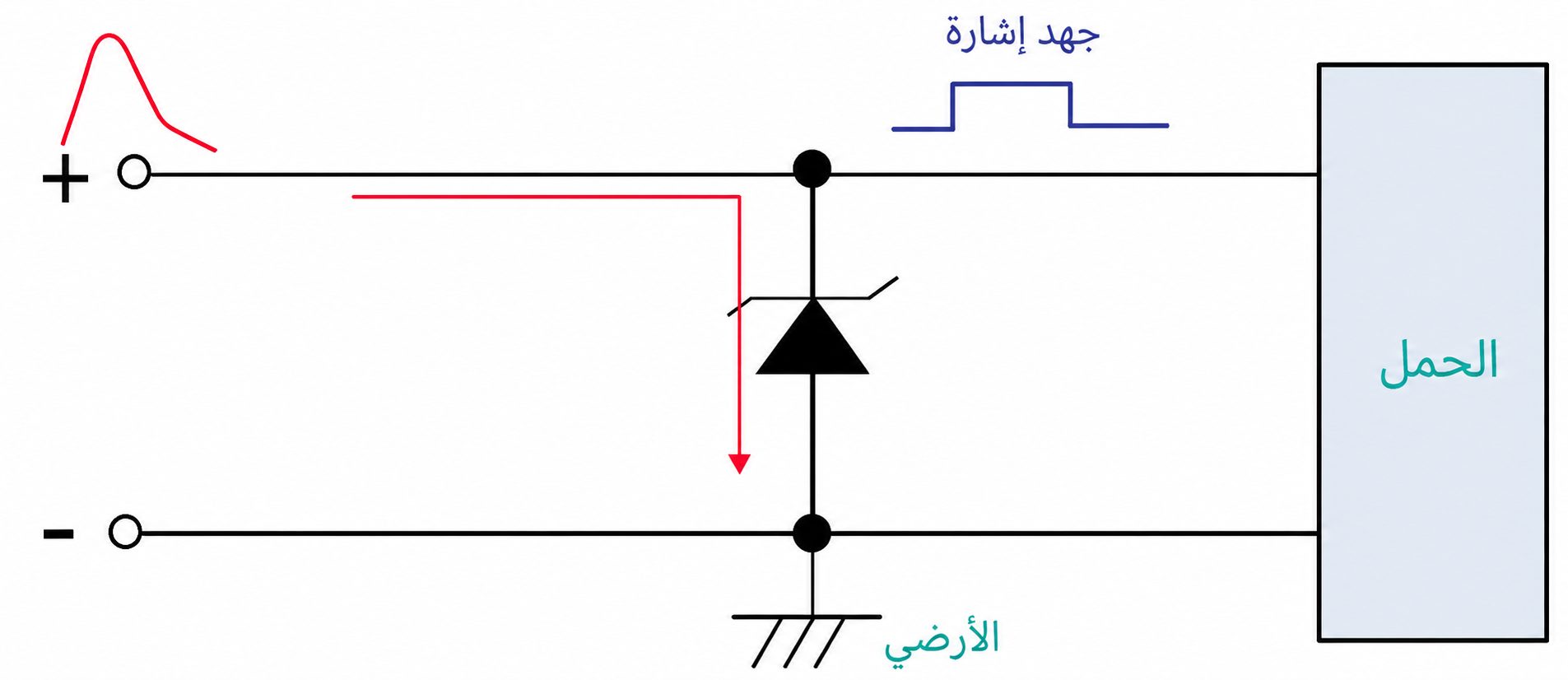
3.1 حماية بثنائي TVS واحد
في هذا التكوين يتم توصيل ثنائي TVS واحد على التوازي مع الدائرة المراد حمايتها.
- يُستخدم للحماية البسيطة والفعالة من الجهود العابرة.
- مناسب لخطوط التيار المستمر منخفض الجهد.
- يُستخدم غالبًا في خطوط بيانات USB والدوائر منخفضة القدرة.
3.2 ثنائي TVS مع مقاومة تسلسلية (لتحديد التيار)
يتم إضافة مقاومة على التوالي لتحديد التيار أثناء حدوث النبضة، مما يقلل الضغط على ثنائي TVS.
- يقلل من تيار الاندفاع المار عبر الثنائي.
- يحسن من مستوى الحماية العام للدائرة.
- يُستخدم في خطوط الإشارة التي لا تتأثر بالمقاومة الصغيرة.
3.3 ثنائيات TVS مزدوجة لحماية الخطوط التفاضلية
يستخدم هذا التكوين ثنائيين من TVS لحماية خطوط الاتصال التفاضلية من الجهود العابرة.
- مناسب لواجهات الاتصال عالية السرعة.
- يُستخدم في RS-485 وCAN Bus.
- يحمي من الجهود الموجبة والسالبة.
- يحافظ على سلامة الإشارة أثناء الحماية.
3.4 مصفوفة TVS (حماية متعددة الخطوط)
تجمع مصفوفة TVS عدة ثنائيات داخل حزمة واحدة لحماية عدة خطوط إدخال وإخراج في نفس الوقت.
- مناسبة لواجهات مثل HDMI وEthernet.
- توفر مساحة على لوحة PCB.
- تضمن حماية موحدة لكل الخطوط.
- تبسط تصميم الدوائر الإلكترونية.
بإختصار
- تلعب ثنائيات TVS دورًا أساسيًا في حماية الأنظمة الإلكترونية الحديثة من الجهود العابرة التي قد تؤدي إلى تلف دائم أو أعطال غير متوقعة.
- إن سرعتها العالية جدًا في الاستجابة، وقدرتها القوية على تحمل تيارات الاندفاع، وخيارات دمجها المرنة في الدوائر تجعلها حلًا مهمًا لحماية الأجهزة من التفريغ الكهروستاتيكي (ESD) وارتفاعات الجهد والنبضات المفاجئة في مختلف التطبيقات.
- ومن خلال اختيار النوع المناسب من ثنائيات TVS (أحادي أو ثنائي الاتجاه) مع التكوين الصحيح للدائرة، يمكن للمهندسين تحقيق حماية موثوقة مع الحفاظ على سلامة الإشارة وأداء النظام بشكل عام.
هل ترغب في الحصول على توصيات لثنائيات TVS مناسبة لتطبيقك؟ شارك متطلباتك في التعليقات.


Leave a comment
You must be logged in to post a comment.