


Makers Electronics sells temperature and humidity sensors for Arduino, ESP32 and Raspberry Pi projects in Alexandria, with delivery across Egypt: DHT11 and DHT22, DS18B20, LM35, thermistors, PT-100, thermocouples and I2C sensors such as the SHT31, AHT21B and BME280. All prices are in EGP, and the live price and stock are on each product page.
Temperature and humidity sensors in stock


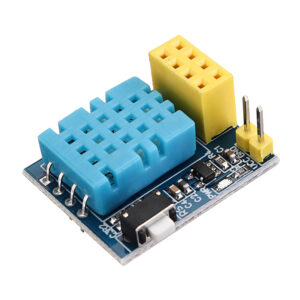
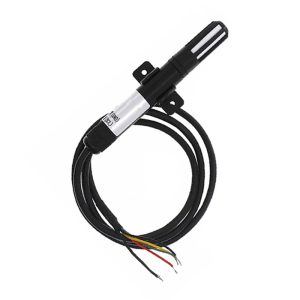


More: browse all temperature and humidity sensors, NTC thermistors and the other sensor types.
Which temperature sensor do you need?
| Sensor | Measures | Output | Typical range | Good for |
|---|---|---|---|---|
| DHT11 | Temperature and humidity | Digital (one wire) | 0 to 50 °C, 20 to 80 % RH | Learning, indoor monitoring, low cost |
| DHT22 | Temperature and humidity | Digital (one wire) | -40 to 80 °C, 0 to 100 % RH | Indoor and outdoor monitoring with a wider range than the DHT11 |
| SHT31, AHT21B, BME280 | Temperature and humidity (the BME280 also measures pressure) | Digital (I2C) | Check the product page | Better accuracy, shared I2C bus, weather stations |
| DS18B20 | Temperature only | Digital (1-Wire), many on one pin | -55 to 125 °C | Waterproof probes, liquids, several points on one wire |
| LM35 | Temperature only | Analog (10 mV per °C) | Roughly 0 to 100 °C (LM35DZ) | Simple analog readings with no library |
| NTC thermistor | Temperature only | Analog (resistance changes with temperature) | Depends on the part; check the product page | Low cost sensing, probes, battery and heat monitoring |
| PT-100 (RTD) | Temperature only | Resistance, needs an amplifier or converter module | Wide industrial range | Accurate measurement and industrial use |
| K-type thermocouple | High temperatures | Tiny voltage, needs an amplifier module | Up to several hundred degrees | Ovens, soldering, hot air, engines |
Quick rules
- Check the supply voltage: many modules run on 3.3 V or 5 V. A 3.3 V board such as the ESP32 needs a sensor or module that accepts 3.3 V.
- The DHT11 and DHT22 are slow: read them about once a second (DHT11) or once every two seconds (DHT22), not in a fast loop.
- A bare DHT sensor needs a pull-up resistor on its data pin. Modules usually include it.
- A DS18B20 needs a 4.7 k pull-up resistor between data and supply (many modules include it). Several DS18B20 sensors can share one pin: each has its own unique address.
- Keep the sensor away from heat sources such as regulators, motor drivers and the board itself. Self-heating gives a reading higher than the real air temperature.
- Do not wet a sensor that is not waterproof. For liquids and wet places choose a sensor on a waterproof probe.
- A thermocouple or a PT-100 needs a separate amplifier or converter module: they cannot be read directly by a pin.
Guides
- LM35 vs DS18B20: how to choose the right temperature sensor for your project
- I2C vs SPI vs UART: choosing the right communication protocol
- MEMS sensors
See also: all sensors in Egypt, light, infrared and colour sensors, motion sensors, and the boards that read them: ESP32 and Arduino.
Frequently asked questions
Which is better: DHT11 or DHT22?
The DHT22 covers a wider temperature and humidity range and gives finer readings than the DHT11, so it suits outdoor or more demanding use. The DHT11 is enough for simple indoor projects and for learning.
Should I choose the LM35 or the DS18B20?
The LM35 is analog: it is simple to read but its value depends on your ADC and the wire length. The DS18B20 is digital, comes as a waterproof probe and lets you connect several sensors to one pin. Our guide compares them in detail.
Can I measure temperature above 125 °C?
Not with a DS18B20, which stops at 125 °C. Use a K-type thermocouple with an amplifier module, or a PT-100 probe with a converter, and check the maximum temperature of the probe cable.
Do you deliver temperature sensors across Egypt?
Yes. Orders to Alexandria placed before 2:00 PM are usually delivered the same day, and orders to other governorates are usually delivered the next day. These are typical times, not a guarantee. Shipping cost depends on the governorate and is shown at checkout. See Shipping and Delivery.
Can I return temperature sensors?
Electronic products cannot be returned or exchanged once opened or used, except for confirmed manufacturing defects. Defects must be reported within 3 days of delivery. Full rules: Refund and Returns Policy.
Do you sell temperature sensors in bulk to schools, universities or companies?
Yes. Contact customer service on +2 0248813824, WhatsApp +20 121 198 1188 or info@makerselectronics.com and you will be connected to the corporate customers team.
Can I visit the store?
Yes: 158 Elhorya St., Elibrahymia, Alexandria, Egypt. Saturday to Thursday 10:00 AM to 8:30 PM, Friday 2:00 PM to 8:00 PM.